US LLCs for Non-Residents: The Form 5472 Penalty Trap
Man, let me tell you about this whole US LLC thing for folks who don’t live here. Sounds great on paper, right? Set up a little company, maybe sell some stuff online, keep it simple. But then the IRS comes knocking with their paperwork, and things get messy, fast. I’ve been through this wringer myself, and trust me, you gotta watch out for this Form 5472 situation.
I started this project thinking it was a piece of cake. A buddy of mine, living overseas, wanted to set up an LLC in Wyoming to sell digital products in the US. No employees, no physical presence, just him and a website. Standard stuff. We got the LLC incorporated, got the EIN, opened a business bank account—all the easy bits done within a month. I felt like a genius.
Then tax time rolled around.
I knew he had to file a Form 1040-NR if he had ‘Effectively Connected Income’ (ECI), which we were trying hard to avoid because he wasn’t doing physical business in the States. The goal was for his income to be treated as foreign-sourced. But even if you don’t owe tax, you still gotta file informational returns. That’s where the 5472 sprung its trap.
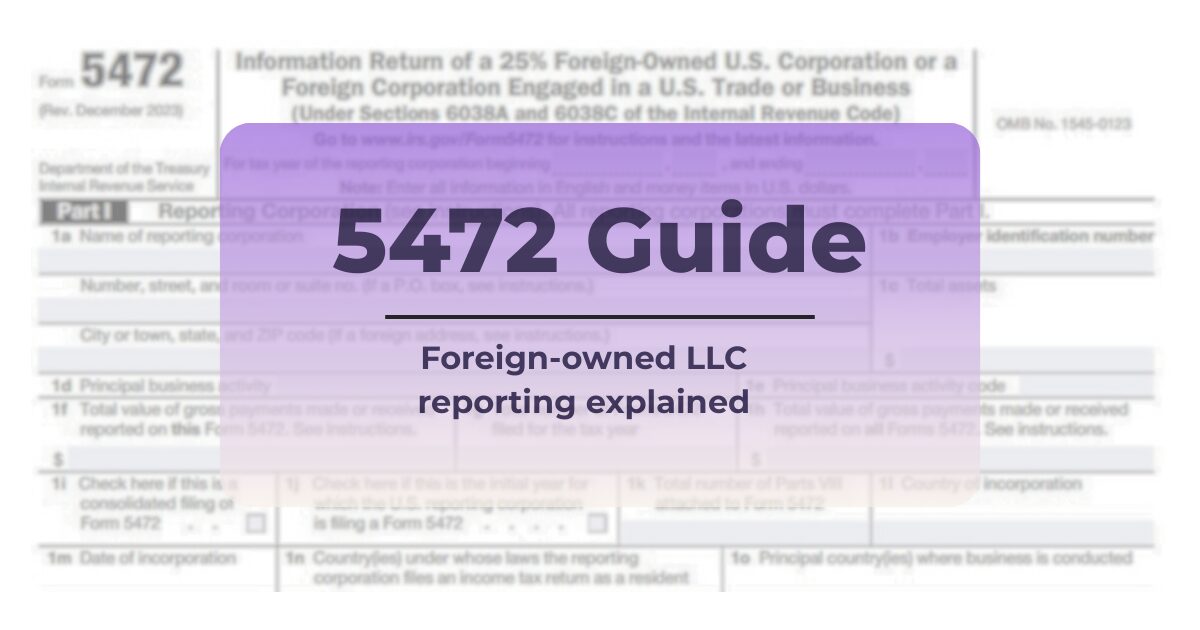
See, when an LLC is owned 100% by a single foreign person (a disregarded entity), the IRS treats it as a branch of the owner for tax purposes. But the kicker is, they consider any transaction between the owner and the LLC as a “reportable transaction” under Section 6038A. This includes things like contributions of capital or distributions—basically any money moving in or out.
My buddy had put in a few thousand bucks to get the website running. Guess what? That’s a contribution of capital. Reportable!
We initially only focused on the 1040-NR and the standard state filings. I filed an extension, thinking we were covered. I talked to a tax preparer who, frankly, only focused on the income tax side. Nobody mentioned the dreaded 5472 or the 1120 pro forma.
I hit Google hard when I saw some forums mentioning 5472 for single-member foreign-owned LLCs.
It was a headache to figure out. You can’t just file a 5472 alone. The IRS requires the foreign-owned LLC to file a pro forma Form 1120 (a corporate tax return cover sheet) just to attach the 5472 to it. It’s like putting a costume on the LLC to pretend it’s a corporation long enough to report the transaction details.
The deadline for this is the standard corporate deadline—March 15th if you follow the calendar year. We were already past that. Major panic mode.
The penalties for not filing Form 5472 are monstrous. We’re talking $25,000 PER YEAR for failure to file, plus more if you don’t correct it after notification. Twenty-five grand for a simple informational return! My friend’s LLC barely made $500 its first year!
I immediately scrambled to get everything together. I had to file the 1120 marked “Foreign-Owned U.S. Disregarded Entity,” and attach the 5472. We listed the contribution of capital as the reportable transaction. Since we filed late, we had to include a reasonable cause statement asking for penalty abatement.
I detailed everything: confusion over the requirement for disregarded entities, the complexity of this specific filing structure (1120 just to attach 5472), and reliance on incomplete initial advice. I signed the form and mailed it off, crossing every finger and toe I had.
It took almost six months of worrying, but we finally got a letter back. They accepted the filing. No penalty assessed because the IRS agreed to the ‘reasonable cause’ plea. Phew. But that stress? I wouldn’t wish it on my worst enemy.
So, the takeaway is: If you are a non-resident with an LLC, even if you are totally disregarded for income tax purposes, you must file Form 5472/1120 pro forma if there’s any transaction between you and the LLC. That $25,000 penalty is real, and the IRS shows no mercy if you mess this up.